
In January 1954, researchers at IBM and Georgetown University unveiled the IBM 701 Electronic Data Processing Machine, which could conduct near-instantaneous translation of Russian sentences into English. Léon Dostert, a Georgetown University professor behind the technology, confidently predicted the prototype was so successful that “five, perhaps three years hence,” electronic translation would be an “accomplished fact”.
It took nearly half a century for that vision to be fully realised. Technology predictions are often wrong, and the start of a new year offers an opportunity to examine other bold predictions that may or may not have come to fruition.
Here are three engineering breakthroughs we were promised for 2026 – and the true state of play.
1. Humans on Mars
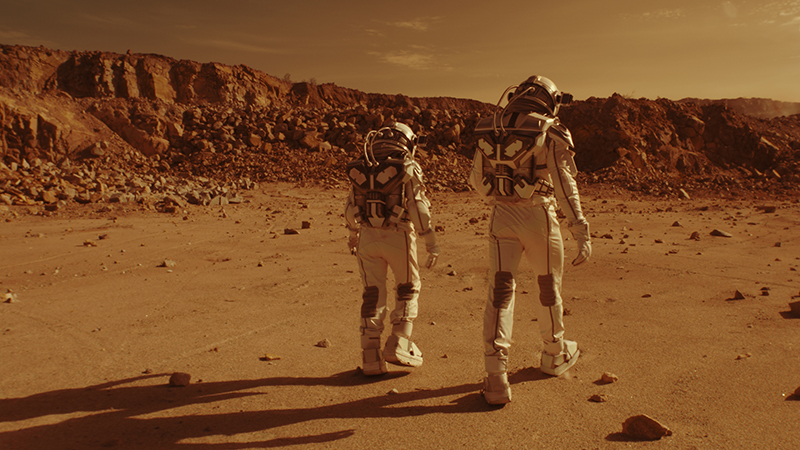
In a 2020 Fox News interview, SpaceX CEO Elon Musk said he thought humans could be on Mars “in six years”. It was a bold prediction then and, as we lurch into 2026, Musk’s assertion looks far more like science fiction than anything rooted in fact.
“I don’t think Musk’s ambitious timeline for sending the first human mission to Mars was ever realistic,” says Lewis Dartnell, professor in science communications at the University of Westminster. “To a certain extent, the tech world is based on a ‘fake it ’til you make you make it’ attitude, and presenting big advances as readily achievable is seen as necessary to attract financial backing and other support.”
But ‘fake it ’til you make it’ does not work when it comes to safely landing the first astronauts on Mars. That “will be a hugely complex – and expensive – endeavour and I think Musk’s proposed timeline is unfeasibly accelerated,” says Dartnell. Instead, he thinks a timeline nearer the 2040s is more achievable.
“Safely sending a human crew is a great deal more challenging” than sending up a Starship, he says, which is SpaceX’s bread and butter. “Every vital system, from life-support to the EDL [entry, descent and landing] on Mars needs to be thoroughly tested to ensure it is utterly reliable for the seven-to-nine-month flight to the red planet and then surface operations.”
The safety concerns will likely win out against any lofty goals of a modern-day space race, Dartnell says. The engineering challenges of understanding what happens if something goes wrong, and developing technology that limits the likelihood of that happening in the first place, is still a long way away.
Another issue is expense: “With any Mars mission, the cost is high due to long transit times,” says Andrew Coates, professor at the Mullard Space Science Laboratory at University College London.
2. Self-driving cars
“If you’d told me 10 years ago we’d have actual cars with no drivers operating safely in complex cities like San Francisco by 2026, I wouldn’t have believed you,” says Jack Stilgoe, professor in science and technology studies at University College London. But they are a common sight in the US city, and cars from autonomous vehicle firms Waymo and Wayve are arriving in London this year, according to the Department for Transport. That follows successful adoption in the US and Middle East in recent months at a more commercial scale than ever before.
But Stilgoe is not convinced that announcements will quickly translate to wheels on tarmac. “There’s a lot of talk about the technology hitting the big time in London in 2026,” he says. But that will be easier said than done. “There are some profound engineering challenges in doing this. London wasn’t designed around the car, let alone a self-driving one. Making the city machine-readable is a huge challenge.” London’s cobbled, winding streets and throngs of tourists crossing roads and stopping to see the sights will be a real test for the technology.
The other half of the problem is how users react. “The bigger challenge is to give people a new mode of transport that competes with all the other options,” says Stilgoe. “London policymakers have been very successful in getting cars out of the city. The only thing worse in terms of congestion than a car with one person in it is a car with no people in it. Will self-driving cars add more problems than they solve?”
3. Flying taxis
The hold-up behind eVTOLs (electric vertical take-off and landing aircraft) is similarly complicated to the challenges facing self-driving vehicles. One challenge is that every vehicle is designed differently to the others, says Antonios Tsourdos, head of the Centre for Autonomous and Cyber-Physical Systems at Cranfield University.
“The second thing that hasn’t been fully resolved yet is their integration in the airspace and the ecosystem,” Tsourdos says. “They are not fixed-wing aircrafts that we know how to handle. They are not helicopters either, which we have some regulations for. It’s something in between.” And that ‘in-betweenness’ means that regulations are still not ready for eVTOLs to operate safely.
The US is changing its regulations to account for the new vehicles, says Stjohn Youngman, chief operating officer of Skyfly Technologies, which is developing the Axe ‘vertically capable aircraft’. “The FAA’s [Federal Aviation Administration] Mosaic [Modernization of Special Airworthiness Certification] changes to Light-Sport certification introduce more pragmatic requirements, creating a faster pathway to get eVTOL aircraft flying and operating in the real world,” he says. Youngman is “hopeful that EASA [European Union Aviation Safety Agency] and the UK CAA [Civil Aviation Authority] will adopt similar regulatory frameworks” – but it could take time.
The result? A technology awaiting true take-off. Tsourdos believes that the timeframe before we should expect such vehicles flying above our cities is not too far away – but he thinks they will only be keenly adopted in modern cities where infrastructure is available to support their operations.